
If you follow the history of Catholic Charities, you’ll see a recurring theme. When a problem arises, Catholic Charities is there to craft a solution.

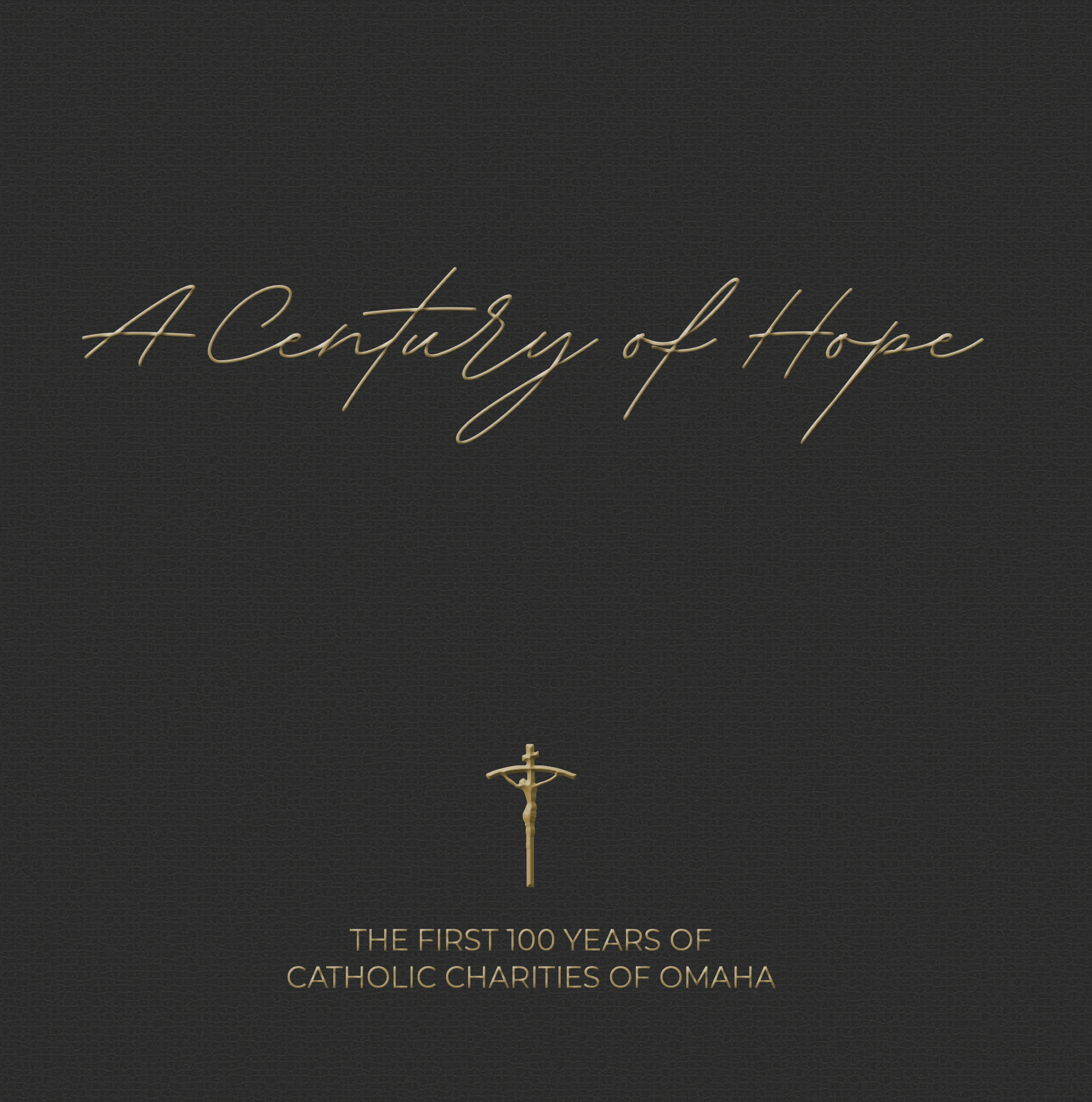
A Century of Hope: The First 100 Years of Catholic Charities of Omaha

Published 2026

By the early 1920s, Catholic social work was well underway throughout the United States. And in sleepy Omaha, a cattle town where sometimes wild economic swings could lead to sudden layoffs and unemployment in the stockyards, that need was especially pressing.

On January 1, 1926, Diocesan Catholic Charities was formed, and a young priest was chosen to lead it.

Throughout its history, Catholic Charities of Omaha has helped the people of Nebraska weather the Great Depression, adapt to the vigorous social changes of the 1960s, add important services to treat alcohol and chemical dependency and even food insecurity, and even managed an orphanage that was Nebraska’s oldest child-caring home. To the poor, the hungry, and homeless, the agency has for a century offered help and hope.

A peek inside

Excerpt from page

Excerpt from page

And while the displacement was frustrating to some, it was also exciting. After all, it meant that the city was entering the modern world. And, so too, was Catholic Charities, in its new quarters at 42nd and Marinda Streets.

Without prying too deeply, one can find some symbolism in the move. After all, around that same time, the Catholic Church was attempting its own ingress into the modern world following the three-year effort of the Second Ecumenical Council of the Vatican, known commonly as Vatican II. Convened by Pope John XXIII with the goal of updating the church, the council met each fall over the three-year-period for sessions of 8 and 12 weeks.

Excerpt from page

The piercing screech of metal. The percussive shock of non-stop jackhammering. The near-constant rumble of unidentified heavy machine engines. The never-ending beeping of those same machines as they move back and forth.

The sounds of heavy highway construction were the sounds of progress, symbols of entry into the modern world. Those were the sounds that had displaced Catholic Charities (and other longtime downtown institutions) in the mid-1960s to make way for the Interstate Highway in downtown Omaha.

Excerpt from page

At Catholic Charities, the agency aimed to embrace modernity while also keeping up business as usual. Its slogan—“Our Business is Helping People”—remained unchanged.

“Our approach to social work at Catholic Charities recognizes that the individual is not isolated, that he has relationships with others—particularly members of this family—which affect him and his problems,” Monsignor Floyd Fischer told the True Voice in 1966. “That is why Catholic Charities is known principally as a family service agency.”

Excerpt from page

Following John XXIII’s 1963 death, Pope Paul VI continued the council’s work and saw it through to its 1965 conclusion.

Ultimately, Vatican II would redefine the Catholic Church. The Mass was updated, greater emphasis was placed on lay participation, inclusivity was encouraged, and dialogue was opened with other religions.

Protestant leaders in the United States largely praised the efforts of the Catholic Church to confront modernity. Evangelist Billy Graham commented that the council fathers “went so much farther than I expected them to go.”

Excerpt from page

Our Recent Work